 Alex Morgan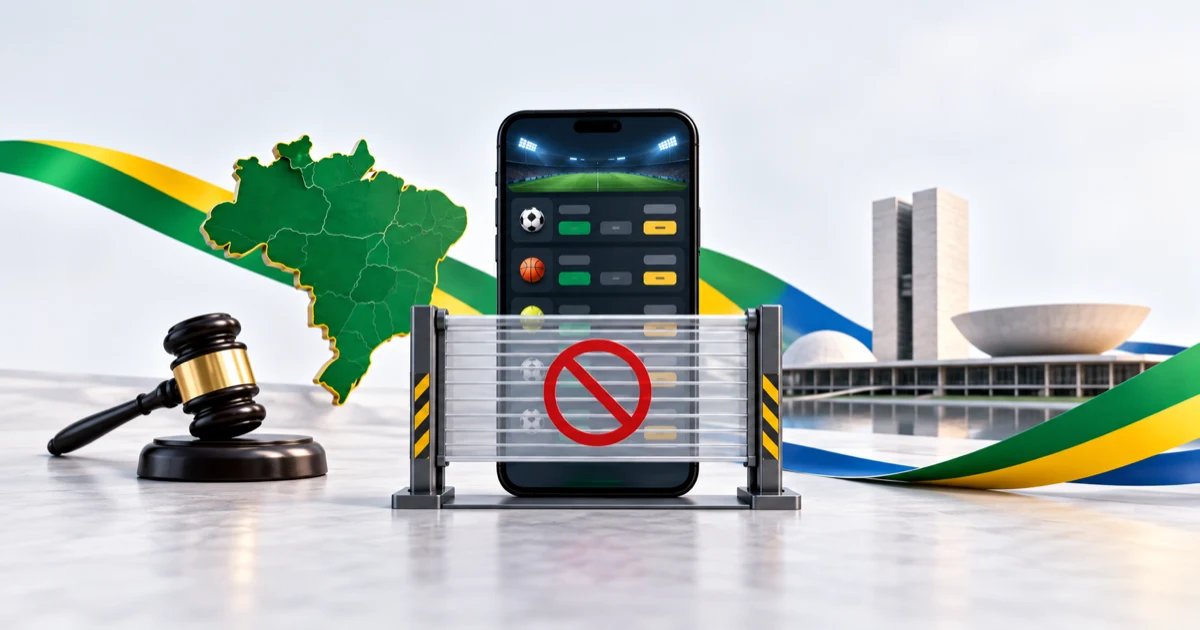
Brazil bans sports betting and online gambling
On September 25, 2026, Brazilian President Luiz Inácio Lula da Silva signed Provisional Measure No. 1,394, known in Portuguese as a Medida Provisória, or MP. It prohibits betting platforms, the acceptance of sports bets, and online gambling.
The measure took effect immediately upon publication. New bets and deposits are already being stopped, while betting sites and apps must be blocked in Brazil from October 6.
What exactly is prohibited
The measure uses the legal term fixed-odds betting. It means a bet whose potential payout is determined by odds known when the bet is placed.
The ban covers betting on real sporting events, online gambling, offering or brokering betting products, advertising, marketing, and sponsorship. State lotteries authorised under separate legislation are not covered.
The measure applies not only to companies registered or licensed in Brazil. It expressly includes foreign operators offering bets to a person located in Brazil. Text of Provisional Measure No. 1,394.
Why Brazil decided to ban betting
The government cites the growth of gambling addiction, household debt, and the social costs associated with betting.
According to figures presented by the authorities, more than 1.3 million Brazilians have already self-excluded from betting platforms. Of those, 51% linked the decision to health problems.
A study cited by the government estimates the annual social cost of gambling at 38.8 billion Brazilian reais (R$38.8 billion). At the official exchange rate of the Central Bank of Brazil on September 25, that was about $7.5 billion. The estimate includes treatment costs, lost productivity, depression, and reduced quality of life. Between 2018 and 2025, gambling-related contacts with the public healthcare system increased by about 140%.
Household debt was another argument. The ban was presented alongside a new stage of Desenrola Brasil, a programme for restructuring overdue consumer debt, with particular attention to families whose debts are linked to betting.
The third reason is the fight against unlawful platforms, money laundering, and organised crime. The government said that 1,367 sites and profiles connected with unlawful activity had been blocked just before the new measures were announced. Brazilian government announcement.
From regulation to a complete ban
Brazil is shutting down not only unlawful platforms but also the officially regulated market created in recent years.
By the time the measure was published, the government had issued 85 betting permits. Each licence cost 30 million Brazilian reais, about $5.8 million, and operators had paid a total of R$2.55 billion, approximately $490 million, in fees.
The measure terminates federal, regional, and local permits. Licence fees will not be refunded, and operators will receive no compensation for investment or lost profit.
How the market will close
The government established the following schedule:
- September 25: the measure took effect; new bets and deposits were prohibited.
- Until 11:59 p.m. on October 5: users may withdraw their remaining balances themselves.
- From October 6: betting sites and apps must be blocked.
- October 6–8: operators will provide financial institutions with information about remaining customer balances.
- October 9–14: banks must return the remaining funds.
- After October 14: Caixa Econômica Federal may act as an intermediary if refunds encounter problems.
Financial guarantees previously provided by regulated operators may be used to return funds if necessary. Official schedule.
What happens to open bets
There is no single public procedure for all operators yet. The first companies have begun publishing their own closure rules.
On September 26, Betano stopped accepting new deposits and bets, offering online gambling, and registering users in Brazil. Open bets settled by 11:59 p.m. on October 5 will be resolved normally.
If an outcome is still unknown by then, Betano will void the bet and return the stake. If the available cash-out value is higher than the original stake, the operator says it will pay the higher amount. These are the rules of one operator, not a market-wide procedure. Betano notice.
The ban is in force but is not yet permanent
Provisional Measure 1,394 has had the force of law since publication, but Brazil’s Congress must still consider it.
Its initial term is 60 days and may be extended by another 60. Congress may approve, amend, or reject it.
The final legal framework may therefore change. The transition schedule is nevertheless already in effect: new transactions are stopping and betting sites are scheduled to be blocked on October 6.
What may happen after the ban
The history of gambling regulation shows that closing an officially regulated market does not eliminate demand by itself. Some people stop gambling, while others look for platforms that continue to accept bets outside the local regulatory system.
That market already existed in Brazil before the new measure. Brazil’s Federal Court of Accounts estimates that operators outside the officially regulated market accounted for 41% to 51% of total betting volume, up to R$40 billion, or about $7.7 billion a year. Closing the regulated offering entirely creates a risk that some remaining demand will shift to those companies. Data from Brazil’s Federal Court of Accounts.
It is important not to reduce this issue to a formal division between licensed and unlicensed platforms. Holding a local licence does not guarantee flawless conduct, while lacking one in a particular jurisdiction does not by itself prove that an operator is acting dishonestly. The practical difference is that within a regulated market the state can set a common minimum standard of protection, supervise compliance, and require intervention when risk is detected. Outside it, those measures depend on the platform’s own rules and the requirements of the jurisdiction in which it operates.
Platforms should therefore be assessed by their actual practices: whether they monitor dangerous changes in behaviour, allow limits to be set in advance, provide self-exclusion, settle bets transparently, and reliably process withdrawals.
In my view, a strictly regulated market remains the more sustainable solution for most players. It is important, however, to distinguish controlled gambling from behaviour in which a person gradually loses control of their decisions. In the first case, a player sets an affordable budget, accepts a loss, and can stop. In the second, bets are increasingly driven by emotion: the person tries to win losses back immediately, raises stakes after losing, breaks their own limits, and continues longer than intended.
Operators should identify precisely this unhealthy pattern. Warning signs may include a sharp increase in deposits and betting frequency, regular late-night play, long sessions without breaks, repeated limit increases, and further deposits after a predefined budget has been exhausted. One incident does not establish addiction, but several signals that intensify over time call for intervention. This protection is especially valuable for the second group: when a person is already making emotional decisions and cannot stop independently, an external restriction may work before the consequences become critical.
Examples of this approach can be found in the United Kingdom and Germany. The British regulator requires online operators to consider financial, time-based, and behavioural signals together, including rising deposits, longer sessions, late-night gambling, chasing losses, declined payments, and multiple funding methods. One strong signal or a combination of less obvious ones should trigger timely intervention.
Germany adds market-wide tools to automated early risk detection. LUGAS monitors the combined deposit limit across operators and prevents simultaneous play on several platforms, while OASIS applies self-exclusion or third-party exclusion across all connected operators. I may examine the player-protection mechanisms used in different countries, their effectiveness, and their disputed aspects in a separate article.
These models are not perfect and cannot eliminate gambling harm entirely. They do, however, show an important advantage of a regulated market: dangerous behavioural changes can be detected and interrupted before they develop into severe addiction and a financial crisis. Under a complete ban, that capacity also diminishes, while demand may remain and move to platforms that do not apply comparable player-protection mechanisms.