 Alex Morgan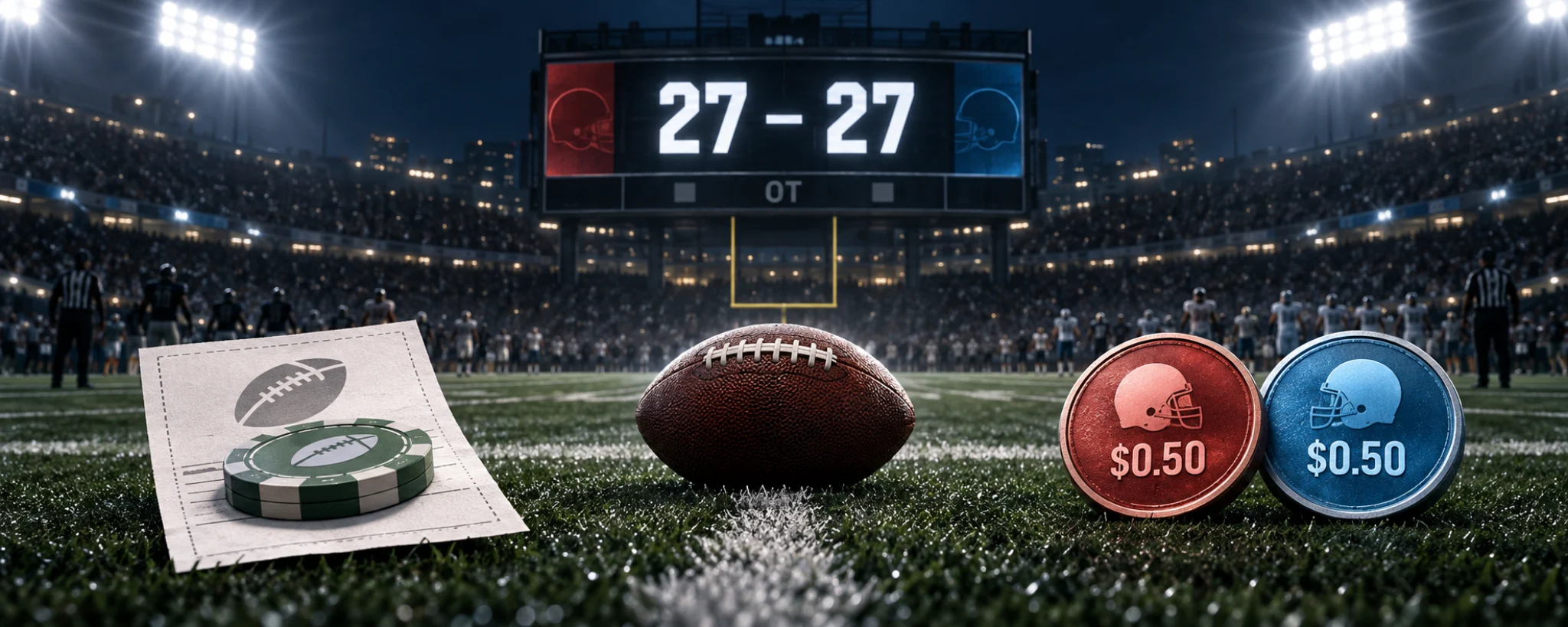
On October 11, the New York Giants and Washington Commanders finished in a rare NFL tie: 27–27 after overtime.
Washington reached the Giants’ 24-yard line on the final drive but failed to stop the clock in time for a potential game-winning field goal. The Giants had previously recovered from a 27–13 deficit, so the tie combined two unusual endings: a comeback and a missed final opportunity.
For a viewer, the result is simple: neither team won. For betting, it is more complicated. The same position on the winner could be refunded by a sportsbook, settled at $0.50 on Kalshi, or lose on a separate tie market. The outcome alone does not determine the payout; the market structure does too.
A two-outcome market can still face a third result
An NFL regular-season game may end in a tie, yet many winner markets show only two selections: Giants or Commanders.
That does not make the tie disappear. The platform defines in advance what happens to a two-way position when neither side wins.
At a traditional sportsbook, the common solution is a push, meaning the stake is returned. On a prediction market, two complementary contracts may instead receive an intermediate settlement value. Those mechanisms produce the same economic result only in certain circumstances.
How bet365 settles a tie on a two-way market
bet365’s NFL two-way market rules state that a game ending in a tie is settled as a push.
For a straight bet, the entire stake is returned. A $100 bet on the Giants comes back as $100: no profit and no loss.
In a parlay, the pushed selection is generally treated as a non-runner. Its odds become 1.00 while the remaining legs continue to determine the payout.
This applies specifically to a two-way market. If a sportsbook offers a three-way market with Giants, Tie and Commanders as separate selections, a bet on either team loses when the score finishes 27–27.
What happened to the Kalshi contracts
Kalshi offered contracts on each team winning this game. The rules for the Giants–Commanders market specified that if the game ended in a tie, each team contract would settle at $0.50.
That is not the same as refunding every trade. The result depends on the contract’s purchase price:
- a Giants contract bought for $0.40 earns $0.10 before fees;
- the same contract bought for $0.63 loses $0.13;
- only a purchase at exactly $0.50 produces a flat result before fees.
Kalshi also listed a separate tie market for this game. Its Yes contract settles at $1 after a tie and No settles at $0. That is a direct position on whether the game will tie, rather than a special settlement rule for the winner market.
Why 50 cents is a logical settlement
The Giants and Commanders contracts represent the two opposing sides of one question. Normally, the winning team’s contract pays $1 and the losing team’s contract pays $0. Their combined payout is $1.
In a tie, neither side satisfies the condition of being the sole winner. Settling both at $0.50 preserves that total value:
$0.50 + $0.50 = $1.00
This is not a probability estimate made after the game. It is a pre-established settlement rule for a result in which neither of the two contracts can be declared the only winner.
How a “risk-free” hedge becomes a loss
The distinction matters most when someone tries to cover opposing outcomes across different platforms.
Consider an illustrative example. These are not historical Giants–Commanders prices, but a simplified model:
- $100 is bet on the Giants at sportsbook odds of 2.70;
- 270 Commanders contracts are bought on Kalshi at $0.63;
- the contracts cost $170.10;
- fees are excluded for simplicity.
If the Giants win, the sportsbook profit is $170 and the Commanders contracts lose $170.10:
$170 − $170.10 = −$0.10
If the Commanders win, each contract earns $0.37 while the sportsbook bet loses:
270 × $0.37 − $100 = −$0.10
The two sides appear almost perfectly balanced. But if the game ends in a tie, the sportsbook returns the $100 stake while every Commanders contract bought at $0.63 settles at $0.50:
270 × ($0.50 − $0.63) = −$35.10
Instead of a nearly flat result, the position loses $35.10 before fees.
The tie itself is not the problem, and neither platform has made an error. The hedge combined markets with different settlement rules. A refunded bet and a contract settling at $0.50 are not perfectly opposing instruments.
A matching market name is not enough
“Giants to win” can look identical across platforms, but a hedge depends on the details:
- whether overtime counts;
- whether the game can officially finish tied;
- whether the position is refunded or assigned an intermediate settlement value;
- whether a separate tie selection exists;
- how a pushed leg is treated inside a parlay;
- which fees apply;
- which official source controls settlement.
Even when a tie is unlikely, it cannot simply be removed from the model. A rare third outcome may define the entire risk of a position, especially when its two sides are placed on different platforms.
Conclusion
The Giants–Commanders tie illustrates a fundamental difference between a sportsbook bet and a prediction-market contract.
At a sportsbook, a two-way bet may be pushed, returning the full stake. On Kalshi, the team contracts in this game settled at $0.50, so the user’s actual result depended on the purchase price. The separate tie contract was settled as a normal win or loss.
For a straight bet, these are simply different product rules. For arbitrage and hedging, they are a material risk. It is not enough to compare outcome names and prices: every possible settlement scenario must match as well.
Sources: New York Giants official game analysis, Giants notes and statistics, bet365 two-way market rules, Kalshi winner market, Kalshi tie market, Kalshi NFL Game contract terms.