 Alex Morgan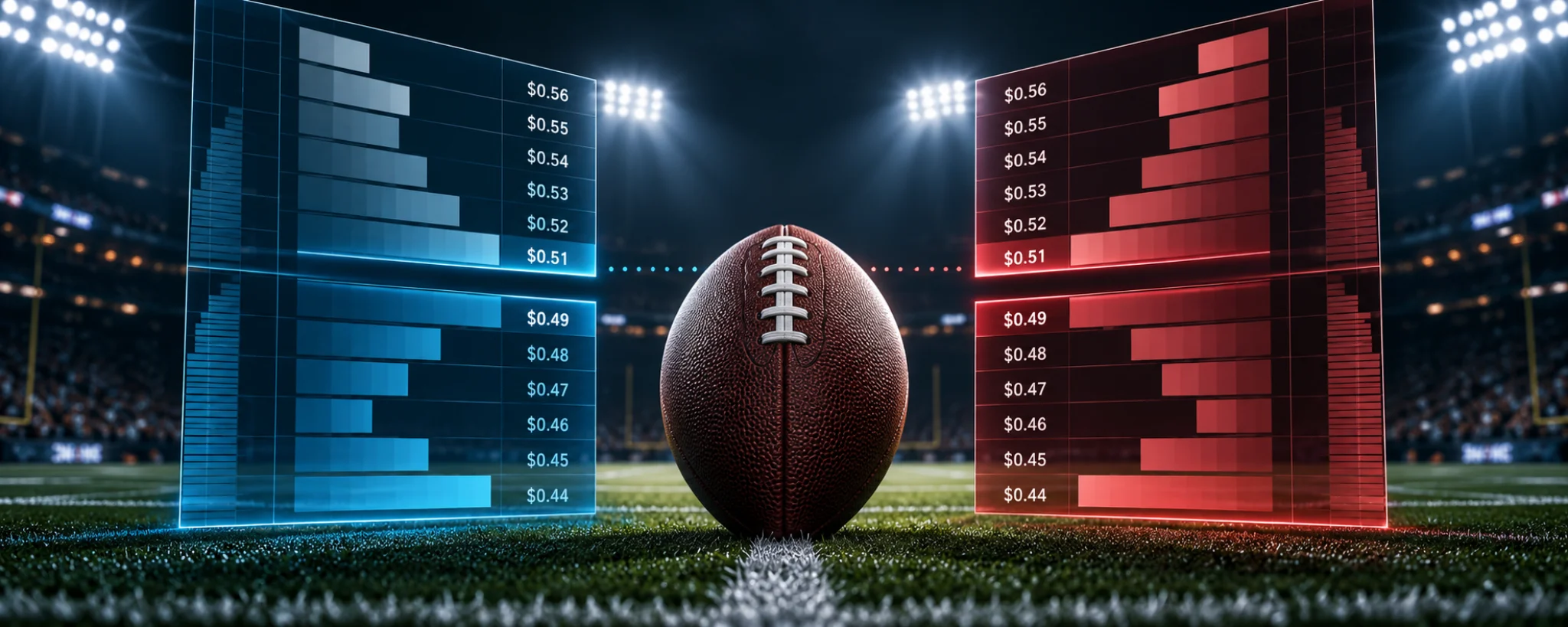
When Kalshi and Polymarket list contracts on the same event, the arbitrage idea looks simple: buy a cheap Yes on one venue and the opposite No on the other. If their combined cost is below $1, one contract must eventually pay a dollar and the difference appears locked in.
In practice, “the prices look different” is several steps away from “the profit is secured.” The contracts need matching settlement rules, executable bids and asks, sufficient depth, fees low enough to preserve the gap, and both legs filled before either book moves.
Vultax Research measured that gap systematically. It ran 32,638 price checks across matched Kalshi and Polymarket contracts covering the NFL, college football, the Premier League, US midterms and a Federal Reserve decision.
The clearest result came from the NFL: across 7,518 pre-game observations, quotes on the two venues did not cross once. There was no arbitrage candidate even before fees.
What the study measured
The observation window ran for 28 hours, from 18:51 UTC on September 12 to 22:51 UTC on September 13, 2026. Every five minutes, the system read public Kalshi and Polymarket APIs and order books.
Sports outcomes were matched by teams and date, then checked against both sets of contract rules. The NFL sample contained 28 matched game outcomes; repeated readings produced 7,518 observations.
The researchers did not compare last-traded prices or a headline probability. They walked both books level by level to calculate how many contracts could actually be bought at available prices.
For each pair, they tested both directions: Yes on Kalshi against the opposite side on Polymarket, and Yes on Polymarket against the opposite side on Kalshi. Both venues’ fees were charged at every level, and the calculation stopped when the next available quantity was no longer profitable.
Sports readings were included only when taken at least ten minutes before kickoff. In-play data was analysed separately and excluded from the main findings.
Three different meanings of arbitrage
1. A difference between displayed prices
One screen may show 48 cents and another 51 cents. That proves very little. One number may be the last trade while the other is the midpoint of the current spread. It may be impossible to buy at either displayed price.
2. Executable quotes cross
A genuine candidate appears when one venue’s ask is below the opposite bid on the other venue. Vultax calls this crossed quotes: the books overlap before fees.
3. Profit survives fees and depth
Even a crossing is not enough. The trader must account for fees on both legs, the amount available at each level, price deterioration while walking the book, fee rounding and the chance that only one leg fills.
Only a positive amount remaining after those checks is potentially executable arbitrage.
What 7,518 NFL checks found
The pre-game NFL sample contained no instance where one venue’s ask fell below the opposite bid on the other:
| Category | Observations | Matched outcomes | Crossed before fees | Profitable after fees and depth |
|---|---|---|---|---|
| NFL, before kickoff | 7,518 | 28 | 0% | 0% |
This is stronger than merely finding no profit after fees. During the measured window, the books did not create an arbitrage even under an idealised calculation with trading costs removed.
That does not mean both platforms always calculated the same objectively correct probability. A more plausible explanation is that pre-game NFL markets were liquid and easy to compare, so market makers and other participants quickly removed meaningful differences.
Vultax reports that during the six hours before kickoff, median depth within two cents of the midpoint was about $1.74 million on Kalshi and $523,000 on Polymarket. With one-cent spreads and that depth, a discrepancy large enough to cover immediate-execution fees on both legs did not survive until the next five-minute reading.
Other markets behaved differently
The same research did find opportunities, mostly outside pre-game sport:
| Category | Observations | Crossed before fees | Profitable after fees and depth |
|---|---|---|---|
| NFL | 7,518 | 0% | 0% |
| College football | 3,220 | 3.4% | 0.1% |
| Premier League | 1,153 | 0.3% | 0% |
| US midterms | 13,440 | 34.3% | 10.1% |
| Fed decision | 1,011 | 38.5% | 33.3% |
College football produced only one observation that cleared fees and available depth, for an estimated $0.21 profit.
Some political gaps persisted much longer, but “arbitrage” still did not mean easy money. One displayed group had a median result of roughly $40.55 on $7,690 of capital, potentially tied up until the election was called.
One long-shot Fed outcome cleared throughout all 337 observations. Its median profit was $714.70, but it required about $325,669 of capital—a return of roughly 0.18% before the cost of capital. Vultax linked the persistent gap to tick size: Kalshi quotes whole cents while Polymarket permits fractions of a cent.
Why slower markets showed more gaps
Sports have a known start time and heavily watched pre-game prices. A meaningful discrepancy attracts participants immediately and tends to disappear quickly.
Political and macroeconomic contracts may settle weeks or months later. Their wording is more complex, their audiences differ, and matching outcomes is harder. Capital can remain locked for a long time.
A gap may therefore persist not because nobody sees it, but because the return is too small relative to settlement time, capital cost, available size, access restrictions and rule risk.
The study used prices from international Polymarket, which US residents cannot access, alongside US-regulated Kalshi. A two-leg opportunity available to different groups of users cannot necessarily be closed by one trader.
Why the in-play results were discarded
During games, 16.9% of readings appeared to show crossed quotes and 7.9% looked profitable after fees. Vultax excluded those numbers.
Each cycle read all Kalshi books before all Polymarket books, leaving up to two minutes between snapshots of the same event. A score or game state could change in that interval. Comparing one venue before a touchdown with another after it creates an arbitrage that never existed at the same moment.
Reliable in-play measurement requires the two books to be captured almost simultaneously—closer to one second than several minutes. Real execution still faces network latency and leg risk.
The same event is not necessarily the same contract
Before comparing prices, both contracts must pay under the same conditions. Traders need to match the precise outcome definition, event window and time zone, postponement and cancellation rules, resolution sources, treatment of ties and disputed results, and settlement deadlines.
The Giants–Commanders tie recently demonstrated why this matters: similar-looking markets can handle a rare result differently. In Vultax’s NFL sample, Kalshi and Polymarket both treated a tie as 50–50, but other categories are not guaranteed to align.
Fed contracts with similar titles, for example, could ask different questions. One priced the size of a rate move while another priced the final rate level. Under some scenarios, both legs of a supposed hedge could settle the same way.
What the study does not prove
Zero opportunities in 7,518 observations does not prove that Kalshi–Polymarket arbitrage never exists.
The study covered one 28-hour window on September 12–13, 2026, sampled every five minutes, and examined a specific set of matched markets. A gap that opened and closed between readings would be missed. A single persistent gap would be counted repeatedly, so observations are not the same as independent opportunities.
The calculation also excluded deposits and withdrawals, capital costs, tax effects and the risk of only one leg filling. Kalshi’s fee coefficient came from an independent source because the official schedule could not be retrieved from the research environment; Kalshi fee rounding was not applied.
The result should therefore be read as a snapshot of a defined period, not a universal law.
Conclusion
The Vultax study answers a more useful question than simply “does arbitrage exist?” It asks what remains of a visible price gap after testing the trade itself.
For pre-game NFL contracts in this sample, nothing remained: across 7,518 checks, Kalshi and Polymarket quotes never crossed even before fees. Political and macroeconomic opportunities appeared more often, but they required capital, patience and careful rule matching.
Different prices on a screen are only the beginning of the analysis. Arbitrage exists only when the contracts are identical, both prices are simultaneously executable for the required size, every cost is deducted, and every relevant outcome produces the expected combined payout.
Source: Vultax Research — Kalshi–Polymarket Arbitrage: 32,638 Price Checks, and Where a Gap Survived Fees. Method and limitations follow the version updated October 9, 2026.